
Essays · The AI-Native Founder
Why Founders Quit While the Market Is Still Fine

THE WEEK IN 60 SECONDS
1 · The slow killer. Many companies end when the founder runs out, before the market or the money does. AI makes the four traps that cause it faster to fall into.
2 · Fewer small funds. The number of emerging venture firms closing a fund fell from 927 in 2022 to 211 so far in 2026, by the PitchBook-NVCA count. The cheques at seed are smaller and the list you need is longer.
3 · Three reads from writers we trust: agents holding too many keys, AI that writes more email without thinking better, and what still protects a product anyone can rebuild.
If you only do one thing: write a one-line ignore list for next week, and keep it where you will see it every morning.
This edition is different. It is an adapted chapter from my book, The Inside-Out Entrepreneur: Chapter 2, on why and how founders fail, rewritten for a founder who builds with AI. I wrote it before agents could build a working product in a weekend. The traps it describes have not gone away; the tools have made each one quicker to walk into. Each trap comes with a move you can make this week.
1 · The failure nobody files a report on
When a startup closes, the post-mortem usually names the market, the money or the product. Those are real. But look closely at founders who stop, and a quieter pattern shows up: the company often ends because the founder ran out first. They lost the reasons they started, the people around them, or the energy to try the next thing, and the business followed.
So I would put the line somewhere else. Shutting down because a round did not come together is a setback with a cause you can learn from. The failure is quitting the game while you could still play it, and that usually starts months earlier, in habits nobody sees.
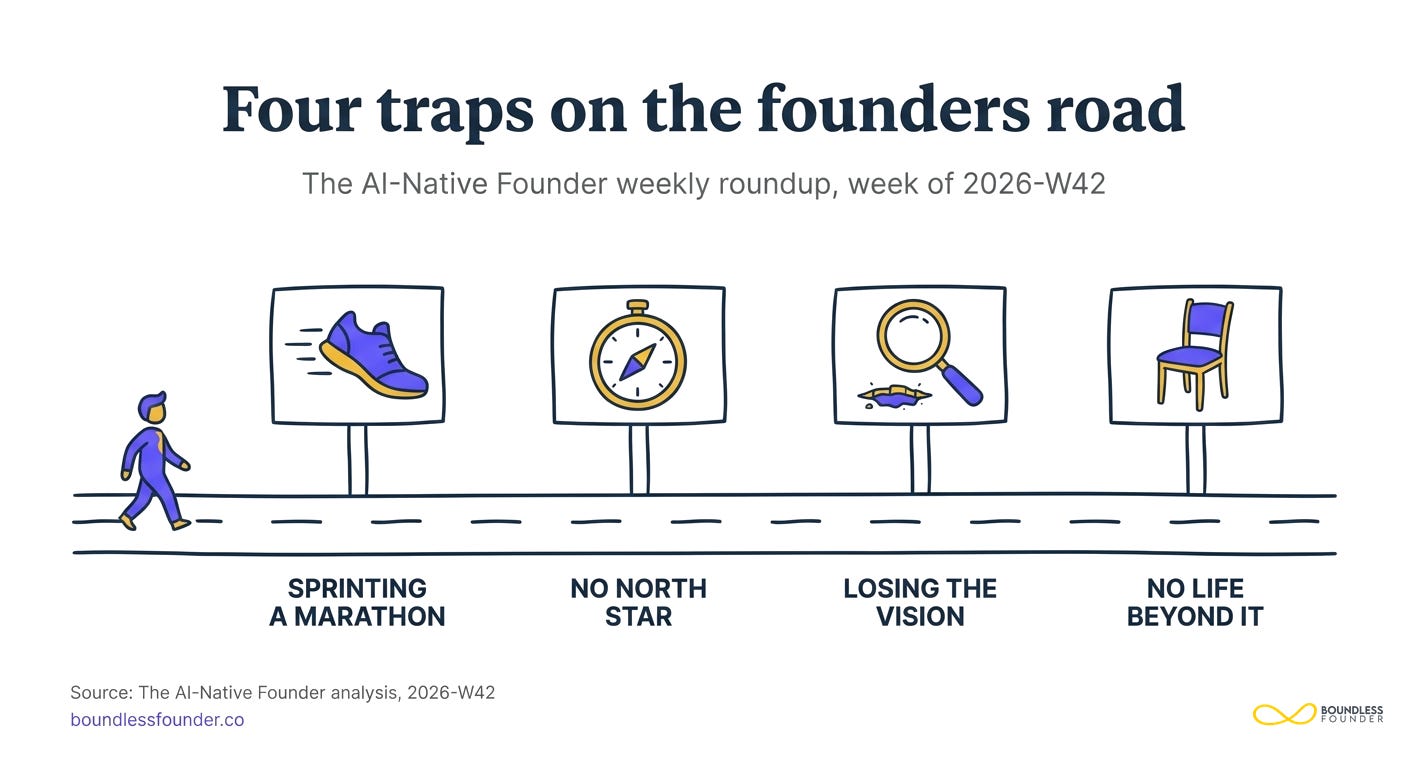
There are four traps behind it. Each one has an AI-native version.
2 · Four traps, and the AI-native version of each
Sprinting a marathon
I went full-time on my startup on September 1, 2017, and expected a burst of progress. I worked sixteen hours or more a day. I crashed in less than a month. Every hour of work seemed to sprout more work: “It was like racing my own shadow.” We had about nine months of runway, and by January my co-founder and I had cut our salaries in half. The company needed a second month I could survive, and I had spent it in the first.
Agents make the shadow faster. When a model can draft the landing page, the outreach and the feature in an afternoon, the list of things you could do grows faster than you can close it, and every item looks cheap. Output feels like progress. It is often only volume.
Venturing without a North Star
When anyone can rebuild a product in a weekend, deciding what to build is most of the job. Without a clear answer to who you serve and what you refuse to build, you drift toward whatever the newest model makes easy, or toward whatever the last investor asked about. Each detour looks sensible on its own, and together they leave you with a product nobody in particular needs.
Losing sight of the vision
A dashboard you check every hour turns a slow week into a verdict. Say signups dip from six a day to two: by lunch you are rewriting the pricing page. Most of those dips are noise, and the energy you spend reacting to them is energy you do not spend on the work that moves the number.
Neglecting life beyond the business
Automation was supposed to give hours back. It is easy to let every saved hour go straight back into the company. The withdrawal from health, family and friends feels free until the account runs dry, and by then it is very hard to fix.
The practical moves you build
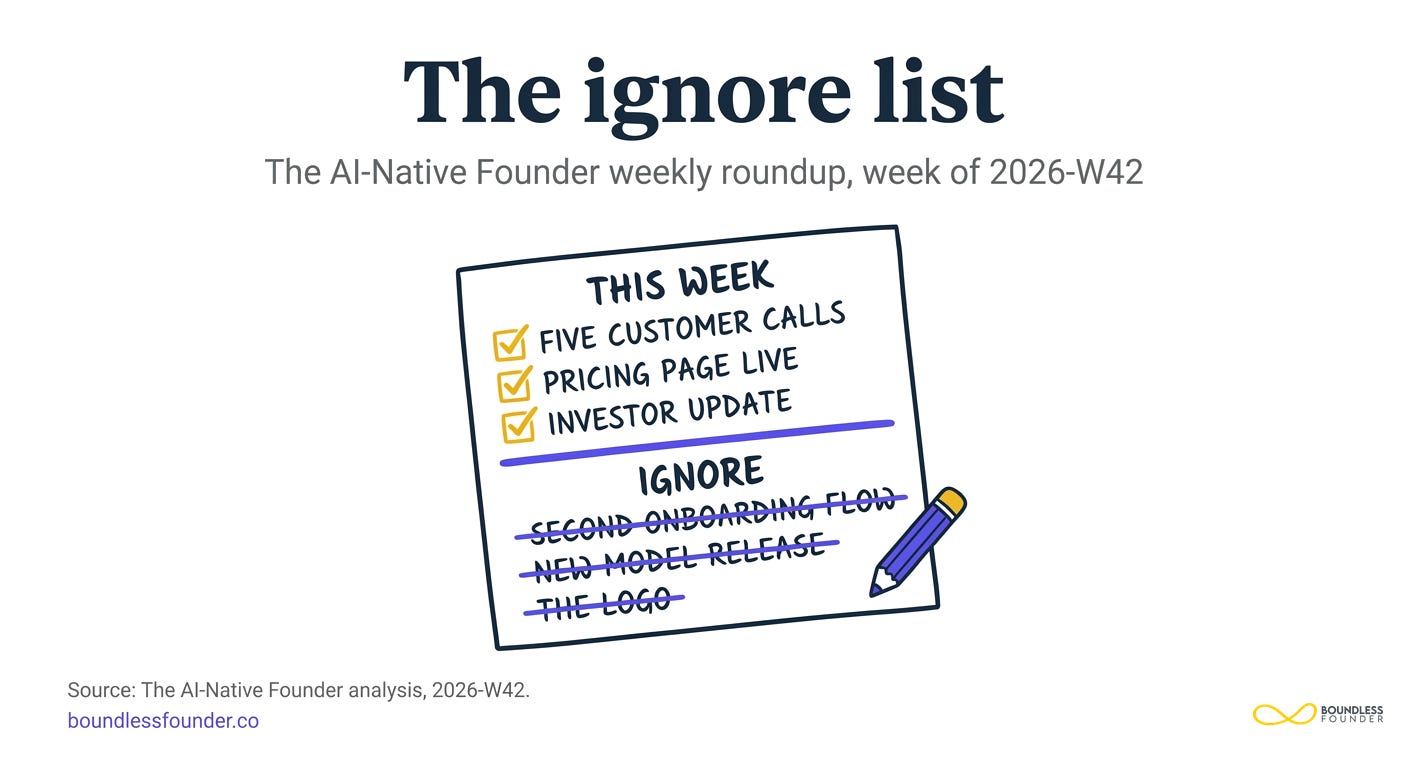
Keep an ignore list, not only a to-do list
Every Monday, write the three outcomes that matter this week and, under them, everything you are choosing not to do. For example: “Outcomes: five customer calls booked, pricing page live, investor update sent. Ignore: the second onboarding flow, the new model release, the logo.” When an agent offers you a fast way to do something on the ignore list, the answer is already written. Set a weekly hours ceiling beside it, and when you cross it, stop adding work and cut instead.
Write your North Star as one sentence with a refusal in it
Use this shape: “We help [who] do [what] without [pain], and we will not build [thing].” A founder building scheduling for physiotherapy clinics might write: “We help small clinics fill cancelled slots without phone calls, and we will not build billing.” Before anything enters the roadmap, read it against that sentence. If it fails, it goes on the ignore list, however easy the model makes it.
Read your numbers on a schedule, with a band
Pick one day a week to read the metrics that matter, and write down how much each one normally moves. If daily signups usually run between two and eight, a day of two is inside the band and needs no reaction. Only a reading outside the band, or the same direction three weeks running, earns a change. Turn off the hourly alerts that are not about something breaking.
Put two things outside work on the calendar as fixed meetings
Pick two, such as a weekly dinner with your partner and three morning walks, and treat them as you would an investor call: you move them only with notice and you never simply skip them. If automation saves you five hours this month, give one of them back to something that is not the company, on purpose and in the calendar.
3 · In the market: fewer small funds at seed
The PitchBook-NVCA Venture Monitor, published on October 7 with data to September 30, says the number of emerging firms closing at least one fund fell from 927 in 2022 to 440 in 2025, and to 211 so far in 2026. Established firms took 88.2% of all the capital raised by US venture funds this year, the highest share in the report’s data. First-time funds raised $4.9 billion across 81 funds, and the median US fund closed this year is $10 million.
For a founder raising a seed round this quarter, this changes the arithmetic. The small funds that write first cheques are fewer, and the typical one is small. Expect more, smaller cheques, and a longer list to fill the same round. A raise may now take noticeably more conversations than the last one did, which is the marathon trap in another form: plan the runway for the longer version.
The move. Before your first meeting, add two columns to your investor list: the date each firm last closed a fund, and that fund’s size. A firm whose newest fund closed in the last two years is likely still writing new cheques; one whose newest fund is five years old may only be backing its existing companies. In each first call, ask one plain question: “How much of your current fund is still set aside for new companies?” The answer tells you whether this is a real lead or a pleasant conversation.
Worth your time
The Agent With Too Many Keys, Uma Rani Karmaker, The TechLaw Nexus. The sprinting trap in security form: an agent handed broad credentials can reach far more than its task needs, and someone chose to hand them over. Her first rule: “Give every agent a distinct, documented identity.”
AI scaled your sending. Not your thinking., Florian, The AI Sales Lab. Output is not progress, applied to cold email: AI should research each account and a person should write the message. His rule fits on a sticky note: “Use AI for the homework, not the handwriting.”
Your Moat Is Dead. Anyone Can Rebuild Your Product., Mathias Klenk, Tech Founder Stack. If a clone can match your features, your North Star has to sit in what a clone cannot copy. His answer: “The strongest moat I know of in 2026 is accountability.”
What’s Next
The four traps are slow, and that is what makes them dangerous. None of them shows up in a single week’s numbers. All of them show up in the founder first. An ignore list, one sentence with a refusal in it, a weekly reading with a band and two fixed dates outside work are cheap to start on Monday.
So, the question I would like you to answer: which of the four traps are you closest to right now, and what tells you?
Hit reply and tell me. I read every answer.
🔓 Want the build, not just the read? The Build Log opens the company books: one startup lesson every Tuesday, for paid subscribers only. Upgrade here.
Mo Ahmed is the author of The Inside-Out Entrepreneur and writes The AI-Native Founder from inside the build.