
Essays · The AI-Native Founder
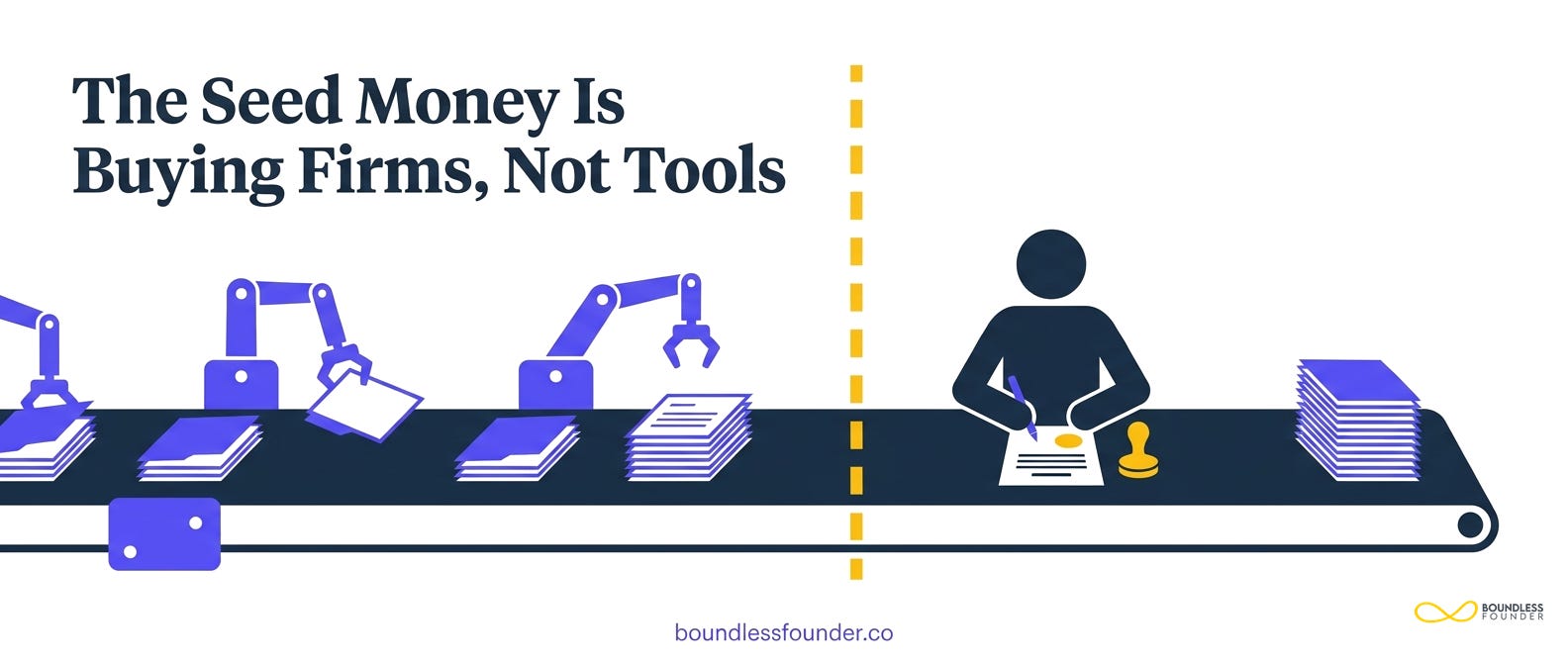
The Seed Money Is Buying Firms, Not Tools
THE WEEK IN 60 SECONDS
1 · Pre-seed money went to companies that do the job themselves. Benford raised €5M to be the auditor, with its own licence, instead of selling software to auditors.
2 · The fastest-growing AI business this week sells judgement. Snorkel’s expert-made datasets passed a $375M run rate, up 18x in a year, at a $3.5B valuation.
3 · The largest cheques paid for controlling what agents can touch. Cyera added $400M to build what it calls the trust layer for the agentic enterprise.
If you only do one thing: write down, on one page, which decisions in your product a named human signs, and put that page in your next sales deck.
Three rounds this week point at the same line in your product: the one between what the software does and what a person is accountable for. Investors paid for companies that drew that line clearly, and a founder at seed can draw it in an afternoon.
1 · The pre-seed rounds bought the whole firm
Benford closed a €5 million pre-seed led by firstminute capital to run statutory audits end to end (Tech.eu, September 22). It already holds a registered audit firm licence in Norway. Its software, AuditOS, connects to a client’s ERP, subledgers, invoices and banks and runs the routine tests, and Benford’s own qualified auditors scope each engagement, rule on the exceptions and sign the opinion.
Co-founder Mads Bogen Øye put the thesis in one line: “Every attempt to modernise audit has been aimed at the auditor’s desk. The firm around it was left untouched.”
The same week, OpenDebt raised A$2 million pre-seed from Blackbird and Antler for debt recovery run by voice AI agents, with SMS and email self-service (Startup Daily, September 22). The design detail matters more than the amount: when someone raises a dispute or reveals financial difficulty, the system is built to stop and bring in a specialist, with the context that person needs. Antler’s partner says the company won multiple ASX-listed customers in six months.
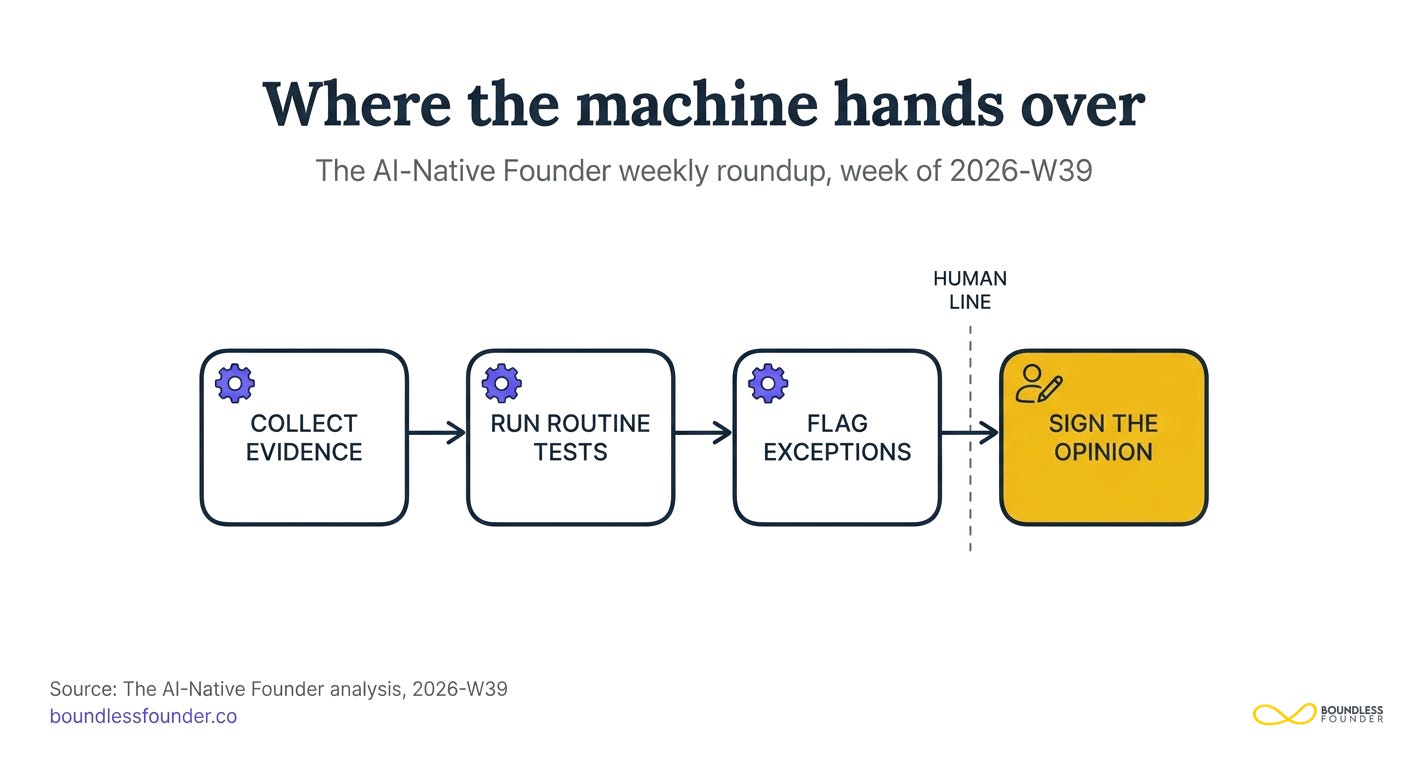
Read these as go-to-market decisions, because that is what they are. Selling audit software means waiting for a partner at an audit firm to change how her team works. Being the audit firm means selling the audit, a thing the buyer already has a budget line for and a deadline to meet. OpenDebt sells to lenders who already pay for collections, and it put the human exactly where a regulator and a reputation would look first.
Neither company pretends the machine carries the liability. They sell the outcome and keep a named person at the point where someone gets sued. For a founder in a regulated or expensive workflow, that is a pricing choice as much as a product one: you charge for the audit, the recovered debt, the closed books, and your margin is the gap between what the work used to cost and what it costs you now.
2 · The fastest grower sells expert judgement
Snorkel AI raised a $350 million Series E at a $3.5 billion valuation, led by Insight Partners and S32, nearly triple its valuation 17 months ago (TechCrunch, September 22). The number that matters is the run rate. Its data-as-a-service business, which delivers finished training and evaluation datasets, crossed $375 million annualised and grew 18x in twelve months.
What it sells is described plainly: data generated by its own software and models “alongside subject matter experts”. The customers are AI labs and large companies. They are paying for a domain expert’s judgement about what a correct answer looks like, packaged so a model can learn from it or be graded against it.
You have free access to that asset and are probably not collecting it. Every design partner you work with employs someone who knows what a good output looks like in their field. Their corrections are the same raw material, and today most founders let them evaporate in a Slack thread.
3 · This week in the market
The largest cheques went to controlling agents. Cyera took a $400 million extension from Goldman Sachs Alternatives, at a valuation of over $12 billion, to build a platform that governs access for “every human, machine, and AI agent” across the enterprise (Cyera, September 22). Your buyer’s security team is being sold a product whose job is to ask what your agent can reach. Expect that question in procurement this quarter, and answer it before it is asked.
At the other end, seed screening is about distribution. An early-stage fund that reviewed close to 25,000 applications in a year reports that 82% of the companies still in business a year later had a strong go-to-market foundation in their deck, and that the most fundable companies describe themselves in one tight sentence (Crunchbase News, September 18). Treat it as one fund’s data rather than a market statistic, and still worth a second look at your GTM slide.
The practical moves you build
Draw the human line and sell it. List every decision your product makes, then mark the ones a named person signs. For an AI bookkeeping product that might be: categorising transactions is automatic, reconciling accounts is automatic with a review queue, filing the VAT return is signed by a qualified accountant on your staff or the client’s. Put that list on one slide. It answers the liability question before the buyer’s lawyer asks it, and it tells you which role you are really replacing.
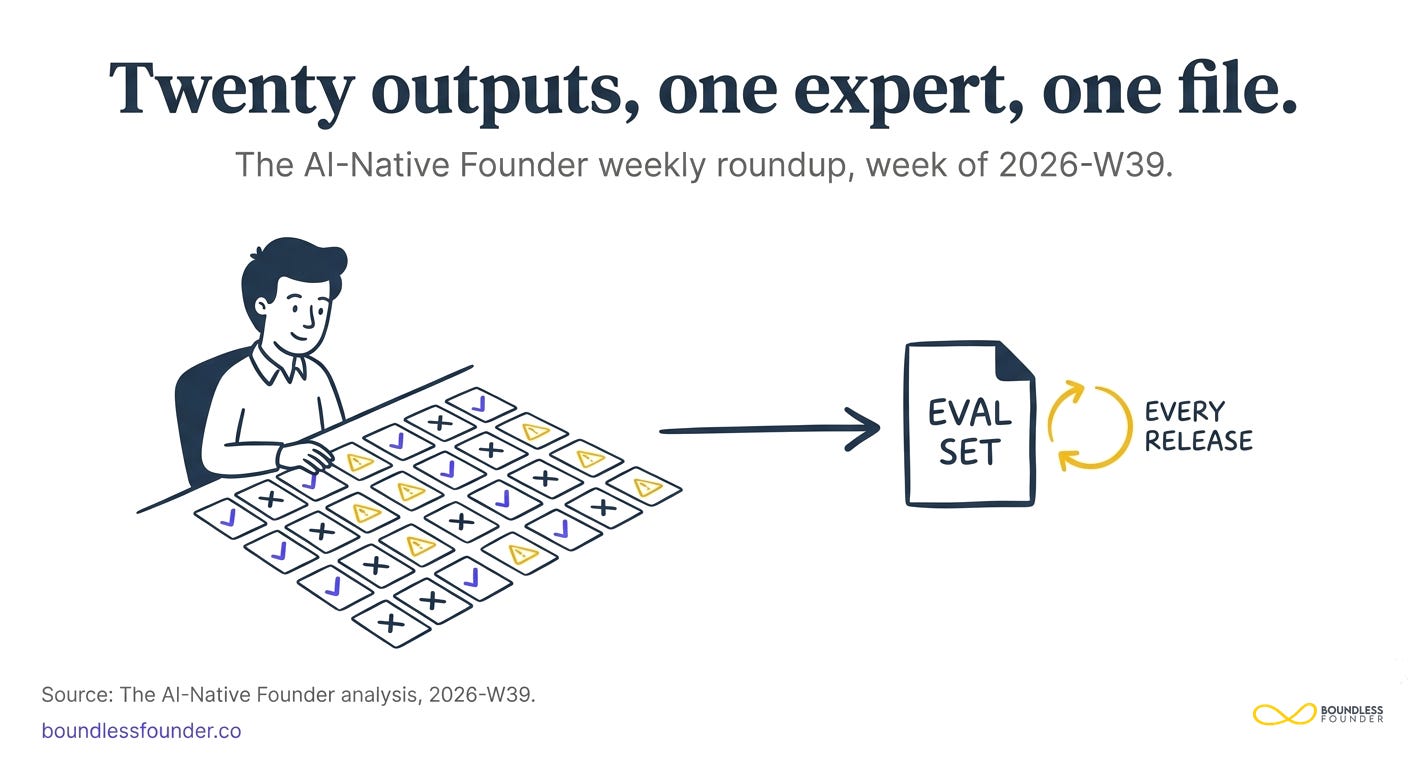
Turn your design partners’ corrections into an eval set. Book 30 minutes with the most senior domain person at one design partner. Show them 20 real outputs from your product and ask them to mark each one right, wrong or unsafe, with one sentence on why. A clinic’s practice manager grading appointment-triage replies is the right shape. Save the 20 inputs, their verdicts and their reasons as a file you rerun on every release. That file becomes your regression test, your sales proof (a line such as “graded by a practice manager, 17 of 20 on the last release”) and the start of the only data moat an early company can build.
Write the access map before security asks. One table, three columns: every system your agent touches, what it can read, what it can change. For a support agent: the helpdesk (read and reply), the billing system (read only), refunds (up to a set limit, above it a human approves). If a row says “full access”, fix the permission before you fix the slide. A security review that gets this table on day one moves in days rather than weeks, and a founder who cannot fill it in has found a real risk.
What’s Next
The week’s money is drawing the same boundary three times. The audit firm owns the signature, the debt-recovery agent hands over the hardship case, and the security platform decides what an agent may touch. Buyers are learning to ask where the machine stops, and the founders who answer precisely get to charge for the whole outcome.
None of this asks you to become a regulated firm. It asks you to know, and write down, which part of your product a person answers for.
So, the question I would like you to answer: in your product today, which single decision would you never let the model make without a human, and have you told your customers that?
Hit reply and tell me. I read every answer.
🔓 Want the build, not just the read? The Build Log opens the company books: one fundraising lesson every Tuesday, for paid subscribers only. Upgrade here.
Mo Ahmed is the author of The Inside-Out Entrepreneur and writes The AI-Native Founder from inside the build.