
Essays · The AI-Native Founder
Sell the Promise, Then Build What Keeps It
THE WEEK IN 60 SECONDS
1 · A legal startup raised on a guarantee. Arceus raised $17M to sell flat-fee contract review to startups, with standard reviews back within eight hours or free.
2 · Agents that crash halfway now have their own infrastructure round. Restate raised a $20M Series A so that multistep agent work survives a crash and picks up where it stopped.
3 · The Strands Agents team at AWS released a 2-billion-parameter model whose only job is the routine choices. Strands Decider makes them in a median of around 115ms, by its makers’ own figure.
If you only do one thing: put a monthly spend limit and a billing alert on every model and cloud account your product runs on, before Monday.
Three announcements this week sit on the same idea from three sides. One startup sells a promise to its customers, one sells the plumbing that lets an agent keep its promises, and one gives away a small model so the routine part of keeping them costs less. If your product runs on agents, all three describe a job you already have: say what the customer gets and by when, then make sure the machine can deliver it every time without the bill running away from you.
1 · The pitch was a guarantee
Arceus raised $17 million in a round led by Greycroft to run an AI-native law firm for startups (Artificial Lawyer, October 1). It reviews commercial contracts for a flat fee, and the line its buyers will remember is the promise: standard reviews are guaranteed within eight hours, or the review is free. Its software, CounselOS, connects to the tools a startup’s sales team already lives in, HubSpot, Salesforce, Gmail and Slack, so the contract arrives with its context.
Look at what that promise does to the sale. A founder buying legal help does not compare model quality, because they cannot judge it. They can judge a deadline and a price. Arceus turned an AI capability into two numbers a buyer can hold it to, and it put money behind the deadline, which is the part a buyer believes.
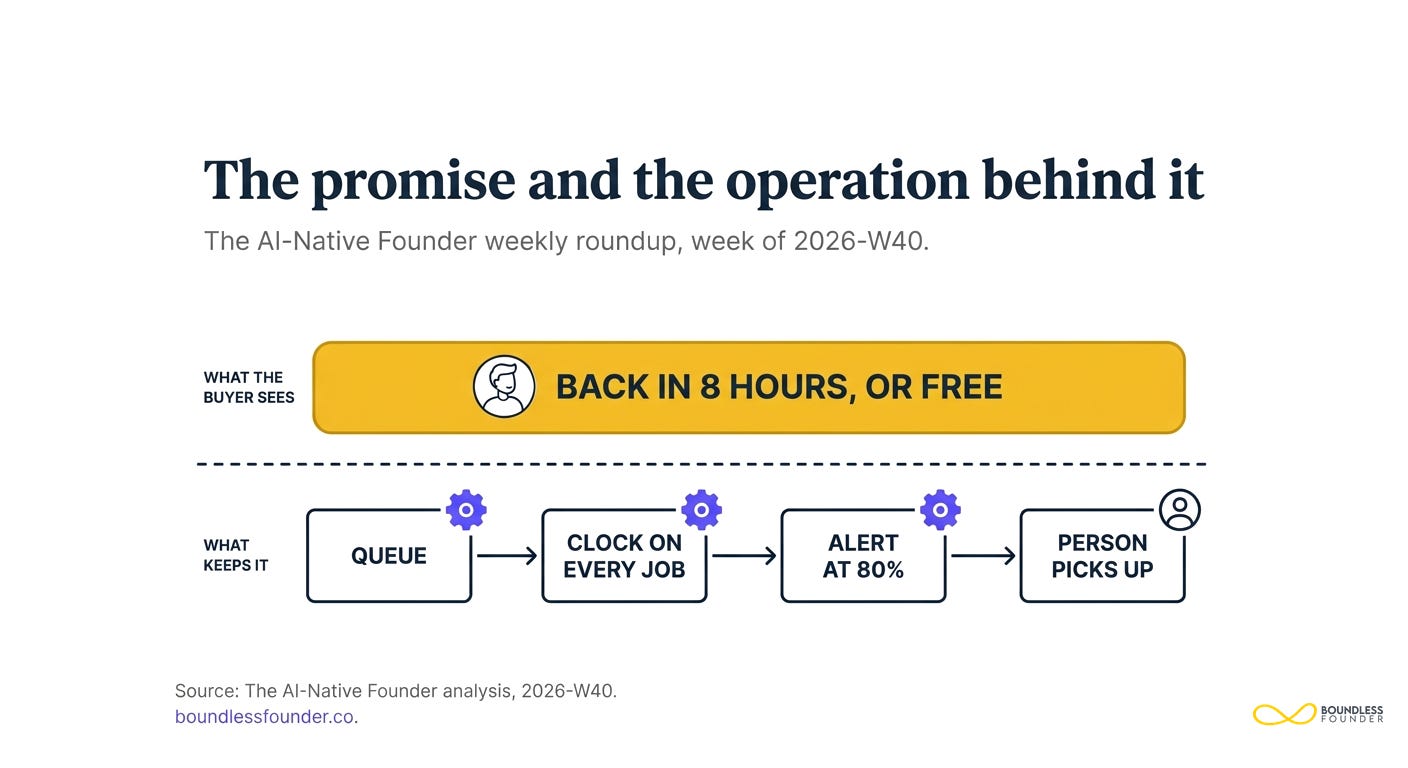
A guarantee like that is only safe when the company knows its own delivery times better than the customer does. It takes a queue, a clock on every job and a person who picks up the ones that slip. The promise is the visible half, and the operation that keeps it is the half a competitor cannot copy from the pricing page.
2 · The plumbing for keeping promises
Restate raised a $20 million Series A led by Singular, with Redpoint and Capital One Ventures, for a runtime that lets multistep agent processes survive crashes and resume (TechCrunch, September 30). Co-founder Stephan Ewen co-created Apache Flink, and Replit is among its customers. The problem it sells against is ordinary: an agent that books, charges and confirms in three steps fails after step two, and on restart it either charges twice or forgets the booking.
The same week, the Strands Agents team released Decider, an open-source model with 2 billion parameters that picks between options and scores them (Strands Agents, October 1). Its makers list the jobs as “model routing, tool selection, evaluations, guardrails, memory, context management, and policy classification”, and they describe the design they have in mind plainly: large models make “the hardest decisions”, and decider models take “the easier rote decisions, reducing cost and latency”.
Put the two together and you get the second half of the Arceus lesson. A promise to a customer is a promise about your own system: that it finishes what it starts, and that each finished job costs less than you charge for it.
3 · The bill that arrived on demo day
In May 2018, after nine months of work, my team showed our first release at a conference in New Orleans. On that first day an email arrived from AWS. About $40,000 of credits, last checked twenty days earlier, were gone, and we owed more than $25,000 on top: $65,000 burned in less than twenty days. The $100,000 in credits meant to last the year had gone in less than six months. We had $75,000 in the bank and fewer than ten employees. The product we were showing that day helped companies cut their cloud bills.
I froze for around twenty days, until AWS called with a thirty-day notice. Then it moved quickly. We got a six-month payment plan first, I pushed for two years, and we settled. A friend helped us get $100,000 in credits from Google, and the team moved the whole stack to Google Cloud in under twenty days. Looking back, “I was working in the problem rather than taking a few steps back and figuring out a solution faster and with much less pain.”
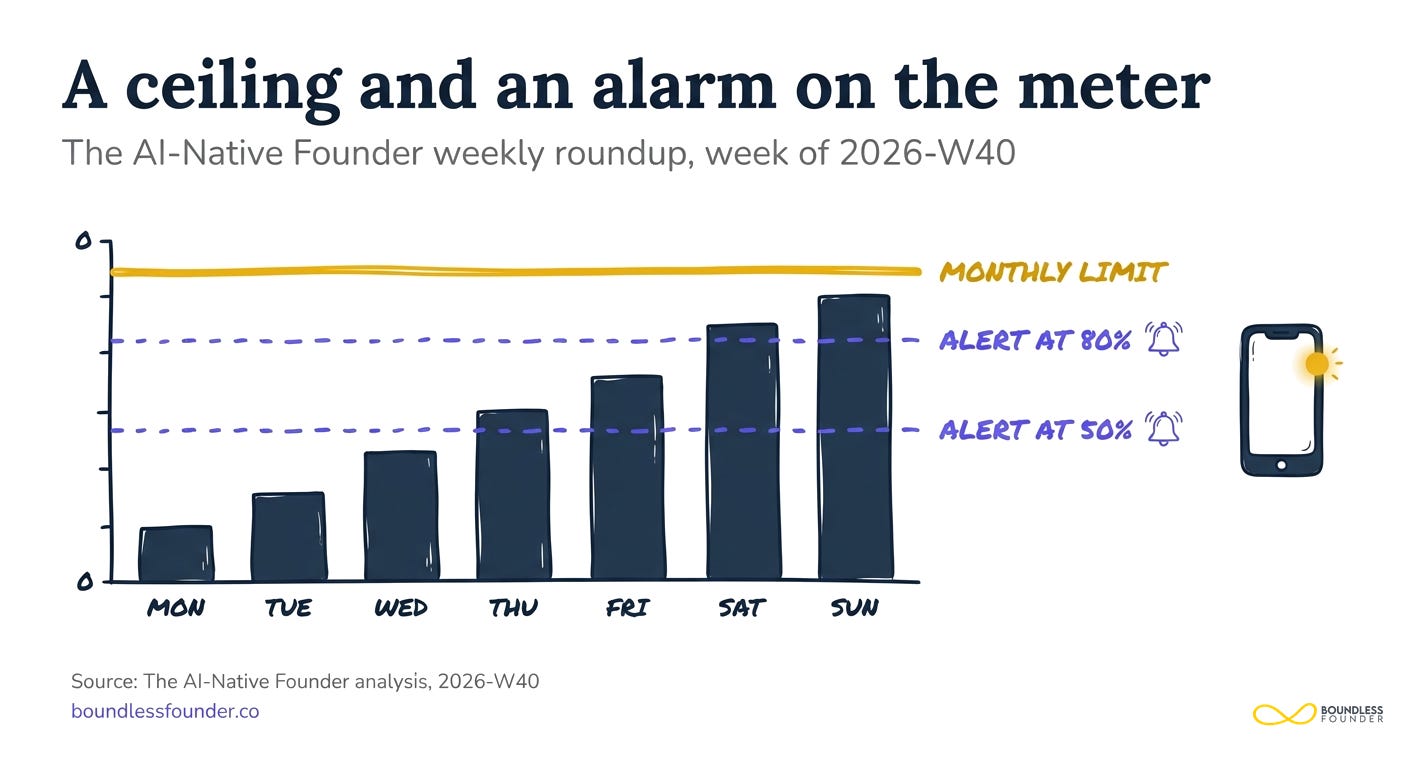
The account had last been checked twenty days before that email. An agent product has the same exposure with a shorter fuse, because a loop that retries all night spends while you sleep. The first move below takes about twenty minutes.
The practical moves you build
Cap the spend and route the routine calls. Today, open the billing settings of every model provider and cloud account you pay. Where a monthly spend limit exists, set it at about one and a half times last month’s bill, and add alerts at half and at eighty per cent of it, sent to a phone, not to a shared inbox. Then log the cost of each job your agent runs. For a support agent, that is the cost per ticket closed. Next, find one rote decision the large model makes on every job, such as sorting an inbound ticket into billing, bug or other. Run your last 100 tickets through a small model and compare its labels with the large model’s. If they agree on the clear cases, send that decision to the small model and keep the hard calls where they are.
Make the loop resumable before you make it faster. Write down your agent’s steps for one job, for example an onboarding agent that creates the account, sends the contract and books the kickoff call. Give each step a record in a table: started, finished, and what it produced. On a restart, the agent reads the table and skips what is finished. Then test it the blunt way: stop the process after the second step and start it again. If the customer gets the contract twice, you have found the bug before they did.
Write a guarantee you can keep. Pull the delivery time for your last 20 jobs. Set the promise at the time you hit on 19 of them, not the average, and name a person who picks up any job that crosses 80 per cent of the deadline. An AI bookkeeping product might say “books closed by the fifth working day, or that month is free”. Put the line on your pricing page for one month and count two things: how many jobs needed the human, and whether more trials converted than the month before. One month is a small sample, so read it as a direction, not a verdict.
Worth your time
The Founder Who Taught Me About Trust Tonight, Sridhar Pai Tonse. A small team with no institutional funding wins against far bigger rivals by staying in one narrow lane and turning down customers outside it. Read it before your next “we can do that too”.
A team for ninety days, not a co-founder for life, Ben Sheppard, Inside Startups. A one-minute video, and also the pitch for his programme. The argument holds without it: a founder who cannot build should not hand out permanent co-founder equity in a hurry when a temporary experienced team can get the first version made.
6 levels to becoming AI native, John Ma, AI Artifact. The level belongs to the task, not the person, and his rule pairs with the resumable loop above: “Move up only when the check at your current level has caught something real.”
The Claude and Gemini Notebook Combo That’s Cutting My Work in Half, Mubashir Burfat, The AI Productivity Lab. One tool does cited research, the other does the reasoning and the writing. He also says the setup only pays for recurring, research-heavy work, which is the honest line most tool posts leave out.
The AI bubble is a problem for the giants but a windfall for founders and angels, Susan Montgomery, Susan | Angel Investor. An angel’s checklist for capital-light AI companies, and one question from it is this issue in a sentence: “As usage grows, does the AI bill grow faster than revenue or slower? Ask to see the invoice.”
The danger of good opportunities., Xaver Lehmann, The Honest Founder. Saying yes to everything early on got him his first angel. Later the same habit filled a calendar he did not want, and he now asks one filter question: “Do I actually want to do this, or am I just happy to be asked?”
ChatGPT Sites vs Claude Artifacts: Why Your Live Dashboard Can’t Be Shared, Dheeraj Sharma with Wyndo, GenAI Unplugged. They built the same dashboard twice. The one you can share keeps its own copy of the data and refreshes it on a schedule, and their advice is to get one manual refresh working before you automate anything.
What’s Next
The money this week paid for keeping promises. One company sells a deadline with a refund behind it, one sells the guarantee that an agent finishes its work, and one shrinks the cost of the routine decisions along the way. None of it is exotic. It is the operation behind the promise, built before the customer tests it.
My own bill arrived twenty days after anyone last looked at the meter. Yours does not have to.
So, the question I would like you to answer: what does your product promise a customer today, in one line, and what happens on the day it misses?
Hit reply and tell me. I read every answer.
🔓 Want the build, not just the read? The Build Log opens the company books: one fundraising lesson every Tuesday, for paid subscribers only. Upgrade here.
Mo Ahmed is the author of The Inside-Out Entrepreneur and writes The AI-Native Founder from inside the build.