
Essays · The AI-Native Founder
27 Billion-Dollar Rounds in One Quarter, and 3 Moves for the Rest of Us
THE WEEK IN 60 SECONDS
1 · The big rounds took the quarter. 27 companies raised $1 billion or more in Q3, a record, and AI startups took 64% of all venture money, by Crunchbase’s count.
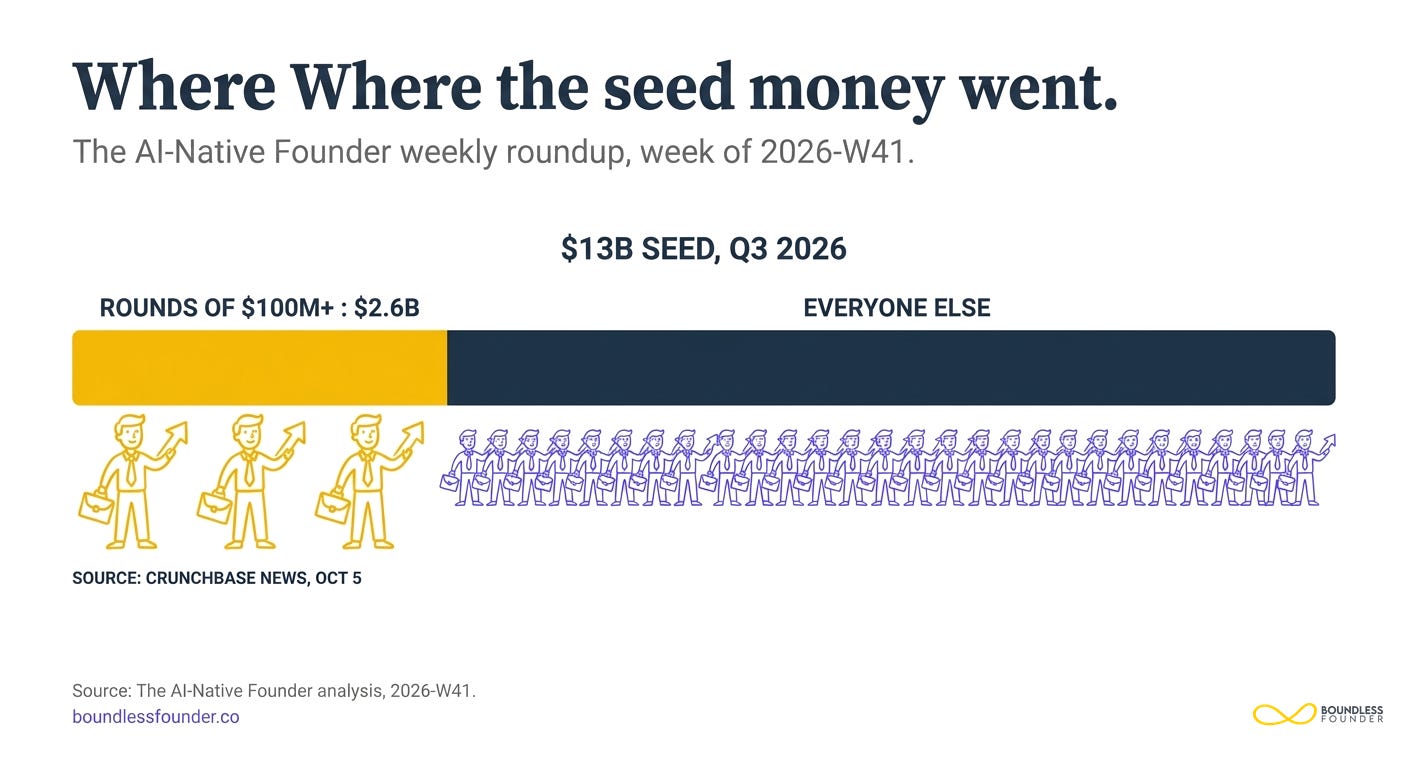
2 · Seed has its own giants now. Seed rounds of $100 million and over made up about 20% of the $13 billion raised at seed in Q3.
3 · Agents are getting a front door. Sierra and Meta published the Personal Agent Protocol, with Shopify, Stripe and Walmart among the partners, so a customer’s AI agent can sign in to a business and act within limits the customer sets.
If you only do one thing: write down what your last five customers spend today on the problem you solve, before you write another line of product.
This week the money concentrated further at the top, and the big platforms began agreeing on how a customer’s agent will knock on a company’s door. For a founder with a small team and a seed round to raise, both point one way: this month favours the companies a buyer, an investor or an agent can check quickly.
1 · Where the quarter’s money went
Global venture funding was $159 billion in Q3 2026, and AI startups raised $102 billion of it, or 64% (Crunchbase News, October 5). An all-time record of 27 companies raised rounds of $1 billion or more, up from 16 in Q2. Seed funding was $13 billion, and seed rounds of $100 million and over made up about 20% of it.
Read that last number twice. $2.6 billion of the quarter’s seed money, a fifth of it, went to a handful of rounds that most founders will never see. The rest of the seed market, the part you are raising in, is smaller than the headline suggests.
A crowded room is won with evidence. An investor who has seen a hundred AI pitches this quarter has heard every version of the vision. What they have not seen is your numbers, and those are the only part of the pitch nobody else can copy.
2 · A standard front door for agents
On October 6, Sierra and Meta announced the Personal Agent Protocol, an open standard for how a person’s AI agent signs in to a business and what it may do there (The Next Web, October 6). Genesys, Instinct, Rocket, Shopify, Stripe and Walmart are partners. A guest agent can check things like stock or a returns policy; once the customer signs in, the customer decides whether it gets read-only or write access. Each company chooses whether agents reach it through its website, its API or its own agent.
Two qualifiers matter. The first version of the specification is due later this month, and payments are listed as a future extension, so nothing here buys anything yet. And Shopify and Stripe have also joined Visa’s rival Trusted Agent Protocol, so the standard is not settled.
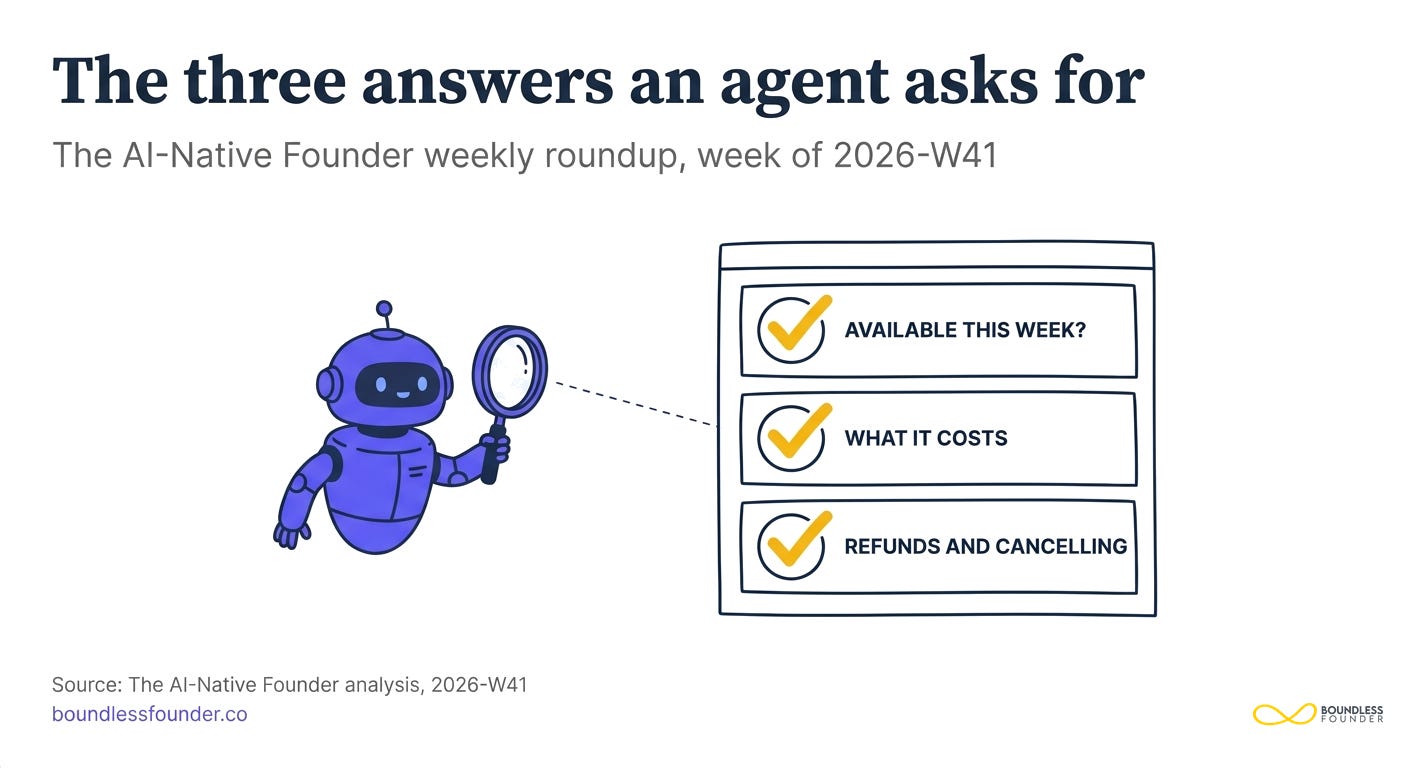
For a founder, the useful part is the direction. The first visitor to your product may soon be a customer’s agent, asking the questions a careful buyer asks: is it available, what does it cost, what happens if I want my money back. If those answers live only in a sales call or a PDF, the agent leaves with nothing.
3 · Two years on a search engine nobody asked for
In the last two years of my PhD, I worked on a semantic search engine without doing any market research. After two years it had not got off the ground. I pivoted, and the new idea went the same way, for the same reason: I was building before asking whether anyone needed it. As I put it later, “I had the mind of an engineer, forever focused on building, often without considering the market’s actual needs.”
Better tools only make that habit cheaper to indulge. Ben Sheppard makes the point in this week’s reading below: building is no longer the hard part. Finding someone who already pays for the problem is, and that is also the first number an investor asks for.
The practical moves you build
Write the money question into your next five calls. Before your next five customer conversations, replace “Would you use this?” with one question: “What do you spend on this problem today?” A founder building contract review for small agencies, for example, might hear “we pay a lawyer $400 a contract, about six a month, and wait four days”. Write each answer in one row of a sheet: who, what they use now, what it costs, how long it takes. After five calls, the sheet tells you whether there is a budget to take, and it becomes the first line of your pitch.
Make a one-page evidence sheet before you raise. Put five numbers on one page and keep them current monthly: what customers spend today on the problem (from the calls above), your cost per successful task, your pass rate on a fixed set of test cases, contracted revenue split from pilot revenue, and retention by cohort after the trial period. If a number does not exist yet, write “not measured” and the date you will have it. An investor reads “not measured, first reading 30 October” as a founder who knows what matters. Bring the page to every meeting, and send it ahead of the first one.
Answer the three questions an agent will ask. Put three answers on one plain public page with no login: whether you can take a new customer this week, what it costs, and how cancellation or a refund works. A bookkeeping service might write “New clients onboarded within five working days. From $300 a month. Cancel any month; no refund for a month already closed.” Link it from your site’s footer and your help centre. Then test it: paste the page’s address into a chatbot with browsing and ask it the three questions. If it cannot answer from your page, a customer’s agent will not either.
Worth your time
How Hidden Inference Bills Are Breaking AI Startups?, Mélony Qin, The AI Entrepreneurs Weekly. Founders price AI products like software subscriptions while their costs scale like a metered utility, so a few heavy users can wipe out the margin. Her rule belongs next to the second move above: “AI inference costs deserve a place in the earliest product roadmap”.
Anyone can build it now. That was never the hard part., Ben Sheppard, Inside Startups. Written for founders who can build almost anything and still cannot find a buyer. The question he teaches is the first move above: “How much do you spend on that solution today?”
He Thought His Company Did $1M. It Did $600K., Todd Gagne, Wildfire Labs. A founder’s own spreadsheet showed a million in recurring revenue; the contracts were invoiced at sixty per cent of what they were signed at. Read it before you fill in the evidence sheet above, because the number you built yourself is the one you check least: “You made it, so you trust it, so you never open it again.”
Raised €500K, Got Married, And Turned Profitable, All In Under 2 Years, Zdenko Zvada, Seedstrapped. A localisation software company that grew on open source, word of mouth and founder-led sales, and treated its small round as a cushion. The line to keep for your next raise: “Go into any raise able to walk away.”
I connected my marketing agent to my partner’s sales agent, Ayush Poddar, StartupGTM. Two agents in one shared channel, answering each other’s questions without waiting on people. His point is the same one this week’s protocol makes at scale: “Knowing something, recommending something and actually doing something need different permissions.”
What’s Next
The money went to a few very large rounds, and agents are learning to check a business before a person calls. Both reward answers a stranger can check. None of it needs a bigger round: five calls, one page of numbers, one page of plain answers.
So, the question I would like you to answer: what does your best customer spend today on the problem you solve, and how did you find out?
Hit reply and tell me. I read every answer.
🔓 Want the build, not just the read? The Build Log opens the company books: one startup lesson every Tuesday, for paid subscribers only. Upgrade here.
Mo Ahmed is the author of The Inside-Out Entrepreneur and writes The AI-Native Founder from inside the build.